
Rastersiebdruck und Farbseparation
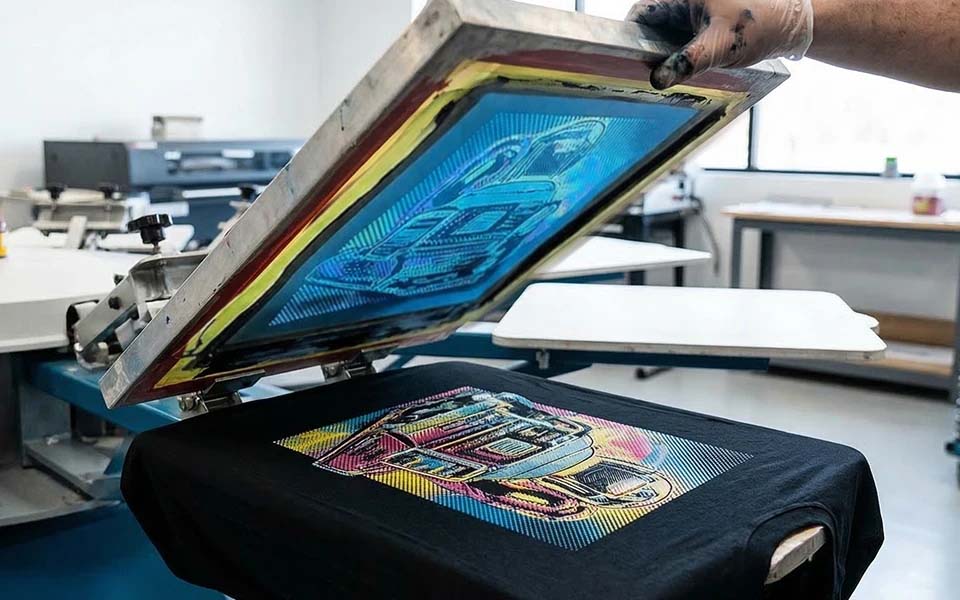
What is the difference to classic screen printing?
In classic screen printing, the individual printing colors are printed cleanly and clearly separated from each other. Each color is applied as its own area. This process is particularly well suited for motifs with clear contours, solid color areas, and distinctly separated colors.
However, as soon as a motif contains color gradients, shades, photorealistic elements, or soft transitions, the normal screen printing with clearly separated solid colors is often no longer sufficient. In such cases, halftone screen printing is used.
How does halftone screen printing work?
In halftone screen printing, colors are not printed as continuous areas, but in the form of very small dots. These dots are set at varying densities. Depending on the size, number, and spacing of the dots, a light, darker, or flowing color tone emerges for the eye from a distance.
This way, intermediate tones can be simulated without having to mix each individual shade as a separate printing color. Thus, color gradients, shades, and detailed motifs can also be implemented in screen printing.
In simplified terms: In halftone screen printing, fine tonal gradations are not created by additional solid colors, but by a dot-based printing screen.
When is halftone screen printing used?
Halftone screen printing is particularly useful when a motif is to be implemented in screen printing, although it is more complex.
Typical applications include:
- Color gradients
- Shades
- Photorealistic motifs
- 3D effects
- Detailed multi-colored designs
- Motifs with soft transitions between colors
For simple logos, lettering, or motifs with clearly separated color areas, classic screen printing is usually sufficient.
What does color separation mean?
For a complex motif to be realized in halftone screen printing, it must first be prepared for printing. This step is called color separation.
During this process, the motif is broken down into the individual printing colors that will be printed one after the other. The goal is to divide the original motif in such a way that colors, gradients, and details can be reproduced as harmoniously as possible in the print.
The quality of this color separation has a significant impact on the later printing result. Therefore, it is carried out not only automatically but also with the involvement of professional software and pre-press specific experience.
Important to know: Even with a high-quality color separation, slight deviations between the original motif and the printed result can occur in screen printing. This is technically normal for complex motifs and should be taken into account in the planning.
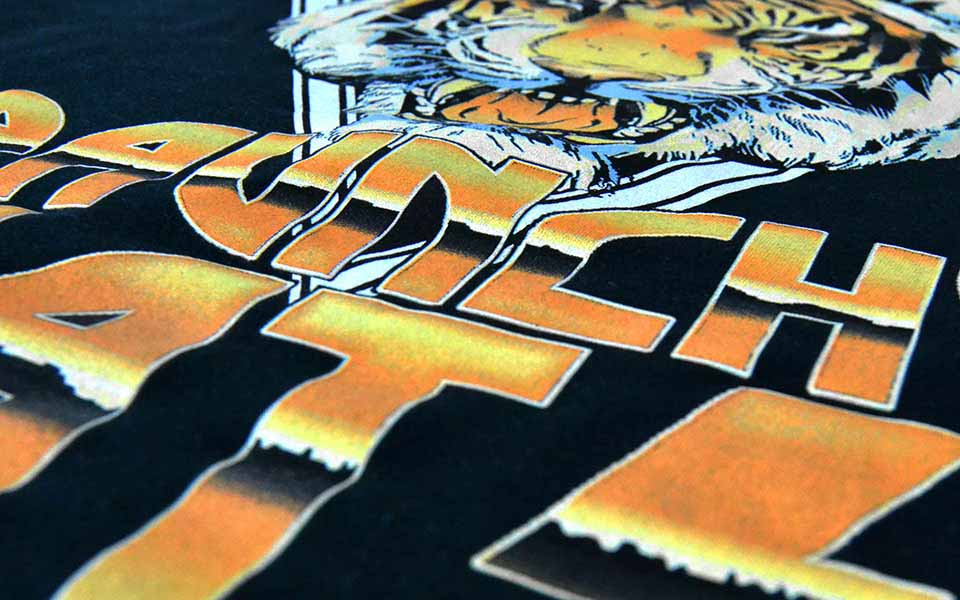
How many printing colors are needed?
How many printing colors are necessary for a color separation always depends on the motif. In many cases, motifs can be implemented with about 6 printing colors. However, the actual required number is not always immediately recognizable and must be checked individually.
If you are unsure, a preliminary analysis of the printing file can be useful. A high-resolution template is a prerequisite for this.
Important prerequisites for color separation
Before a color separation is carried out, the printing file and printing size must be definitively established. Both have a direct influence on the technical preparation for printing and the later result.
Without this specification, no clean separation can be created.
Costs of color separation
There are no additional costs for color separation.
When is halftone screen printing worthwhile?
Since the preparation in halftone screen printing is more complex than with simple screen printing motifs, this process is generally more worthwhile for larger print runs. The greater the quantity, the better the additional effort can be economically justified.
For smaller and medium quantities, digital printing is therefore often the more sensible alternative.
Digital printing as an alternative
If a motif contains many colors, gradients, or photorealistic elements, digital printing is often the more practical solution for smaller to medium print runs. The process does not require color separation in the same way and is particularly well suited for complex motifs with high detail depth.
Especially for manageable quantities, digital printing is therefore often more economical and easier to implement than halftone screen printing.
The most important points at a glance
- Classic screen printing is suitable for motifs with clearly separated solid colors
- Halftone screen printing is used for gradients, shades, and photorealistic motifs
- Intermediate tones are simulated via fine raster dots
- A color separation is necessary for complex screen printing motifs
- The quality of the separation significantly influences the printing result
- Minor deviations from the original motif are technically possible
- In many cases, about 6 printing colors are needed
- The printing file and printing size must be definitively established in advance
- For small and medium print runs, digital printing is often the more sensible alternative