
Digital direct printing (DTG)
What is digital printing?
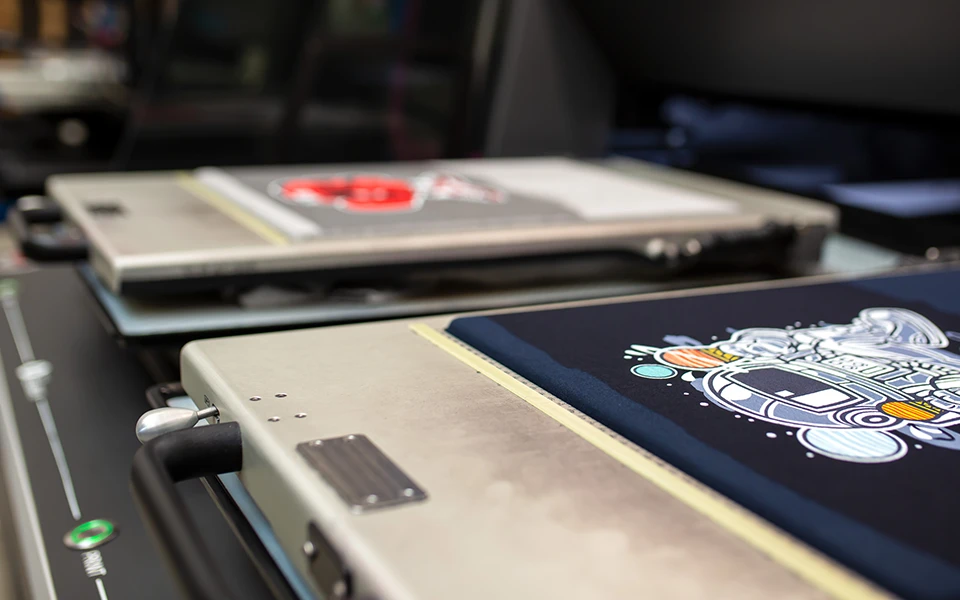
Digital printing, also known as DTG or Direct to Garment, is a printing process in which designs are printed directly onto fabric. The process is particularly suitable for multicolored designs, color gradients, detailed motifs, and photos.
Compared to traditional printing methods like screen printing, digital printing does not require elaborate setup with screens. This makes the process particularly flexible and often a good choice for small to medium runs.
When is digital printing useful?
Digital printing is especially suitable for designs with:
- many colors
- color gradients
- fine details
- photo-realistic elements
- illustrations and complex designs
The process is particularly useful for small to medium quantities when designs need to be implemented quickly, flexibly, and without elaborate print preparation.
Digital printing is also possible on dark textiles. For this, a white base coat is first applied, on which the actual design is then printed. This allows for strong and highly visible print results even on colored fabrics.
How does digital printing work?
The process can best be compared to an inkjet printer. Instead of paper, the fabric is printed directly. Special print heads transfer the design precisely onto the fabric surface.
This allows high-resolution, full-color, and very detailed designs to be brought directly onto the product. This is a significant advantage over printing methods that are more optimized for simple color areas and larger quantities.
What advantages does digital printing offer?
Digital printing is especially advantageous when designs are complex or need to be produced in smaller quantities.
The most important advantages include:
- very good suitability for full-color designs
- clean representation of color gradients and photos
- high detail accuracy
- no elaborate screen setup needed
- flexible for small to medium runs
- printing on light and dark fabrics possible
- pleasant tactile feel and good wearing comfort
- high wash resistance and durability
Thanks to modern printing technology, high-quality results can be achieved that are both visually appealing and durable.
Print quality and color reproduction
Digital printing allows for a very high resolution and is particularly suitable for designs where many colors or fine gradations play a role. Strong contrasts, illustrations, and detailed layouts can also usually be implemented very well.
However, it is important to know that digital printing is not always the best choice for maximum color consistency. When a very precise color reproduction is required, such as with fixed corporate design colors or sensitive company logos, screen printing may be better suited depending on the design and requirements.
With digital printing, slight variations in the print result may occur depending on the fabric, fabric color, and material batch. For many designs, this is unproblematic, but it should be taken into account for strictly defined brand colors.
For which runs is digital printing suitable?
Digital printing is particularly suitable for small to medium runs. Since no traditional screen setup is necessary, the process is economically viable and flexible, especially for lower quantities.
As soon as designs are very simple and the run significantly increases, screen printing may be the more economical alternative depending on the design and color count.
A general rule of thumb is:
- small to medium runs with many colors or color gradients: usually digital printing
- larger runs with clear solid colors: often screen printing
What print file is needed?
A clean print file is crucial for a good print result.
For white fabrics, designs can generally also be created as classic image files. Ideally, 300 dpi in the desired print size is suitable, although 150 dpi is often sufficient in many cases.
For colored fabrics, the design should be isolated or have a transparent background. Suitable file formats that support transparency include:
- PNG
- PSD
- EPS
- AI
- SVG
It is always important: The better the source file, the better the basis for a clean print result.
If you are looking for detailed information on the requirements for the print file, the design requirements are the appropriate area.
When is digital printing less suitable?
As flexible as digital printing is, there are areas of application where other methods may be more appropriate.
Digital printing is generally less suitable for:
- very large runs with simple designs
- when fixed special colors must be precisely matched
- when corporate design colors need to be reproduced particularly consistently
In such cases, screen printing may be the more suitable solution.
The most important points at a glance
- Digital printing prints the design directly onto the fabric
- especially suitable for color gradients, photos, and detailed designs
- makes sense especially for small to medium runs
- also possible on dark fabrics
- high detail accuracy and good wash resistance
- not always the best choice for maximum color consistency for company logos
- a high-quality print file is crucial for a good result